 Achieving a balance in life is more easily said than done, and I have been somewhat hampered in my pursuit of this by several factors, including brain injury-aftermath and the failure, over the last year, by the education system, to provide my son with his legal right thereto. Thankfully, we were approached by a school which seems to be a perfect match for Daniel, and I am delighted that the transition can commence this September.
I sense, therefore, the approach of a new chapter, one which, I hope, bears positive fruit in terms of Daniel’s self-esteem, confidence and finding his academic and emotion-processing footing.
I am also experiencing transition in myself. I was very struck, about ten days ago, by Roger McGough’s discussion, on Radio 2, of the subject, “What makes us human?” As a pedant, I always shout, “Your DNA!” at the radio, but there was something about the 83 year-old poet’s manner that spoke to my heart. Over the last three years I have embarked on a fitness mission which, mentally, emotionally and physically, has proved beneficial in the extreme. Ever since I heard, at a conference in 2017 about sensory issues in children on the autism spectrum , that proprioceptive activity can have a calming effect on children with ASD, I have had mixed results with Daniel, and tremendously positive ones for myself. Firstly, children with ASD are acting from an unconscious ‘prompt’ which is the anxiety that arises out of their difficulties processing stimuli; secondly, when Daniel becomes agitated, it is the manifestation of abject fear, and having the strength to hold him firmly in order to reassure as much as to restrain is invaluable. Additionally, my ability to remain calm comes, in no small measure, from my picking-up and putting-down of heavy objects.
Inspired by this, I set out to study to become a fitness instructor and, last year, passed the initial module of my training towards becoming a Bodypump™ instructor. I was already finding it difficult to set aside the time to complete the work books sent to me by the organisation with whom I was training to attain a Level 2 certificate in fitness instruction and, when my son did not go to school last September, it wasn’t just the time I found it hard to manage. My mental health did indeed suffer, and I went to the gym, when I could, just to try to manage my moods and my brain chemistry in order to enable myself to continue to function as an emotionally and physically available parent for my son.
This enabled me to be either more or less successful as a parent and as advocate for my son, whose entitlement to education was, quite frankly, shat on by the ‘powers that be’ (I use the term advisedly). I discovered that this country is administrated by morons and that, as a result of the combination of these and bureaucracy, nothing gets done for aeons, and you have to continue to fight, tooth and nail, for every little (inadequate, as it turns out) bit of support or activity on your child’s case. Unfortunately, the standard of assistance is so poor, and the mistakes so frequent, that one ends up hard-pushed to find an appropriate outlet for one’s infernal frustrations. One’s mental health suffers further, and quite how I got through last Christmas remains a little bit of a mystery to me. A combination of my medication, stubbornness, machismo and love for my son somehow helped me to get through it.
I began to write, as a means to process the situation and as a pressure-valve; I caught myself knocking out the odd bit of poetry and enjoying it; I re-read Brave New World – which was like experiencing it anew, since the brain injury has wiped or muddled much of the memory of books I have read and loved, and I embarked upon Nineteen Eighty-Four, intending to read the great Dystopian novels of the 20th century, since I seemed to be living a Kafka-esque nightmare but couldn’t quite recall how I knew this.
I became increasingly reconnected with my first love: writing. I experienced a little elevation of my levels of self-esteem, and began to remember, rather foggily, who I had been before, and before the brain injury, and before the relationship that I had got into prior to that, in which, operating out of a paradigm that I had deductively developed as a child, watching my mother get ‘rescued’ by men, I put down all the things that gave me self-esteem in order to stay in the relationship which was, as it turned out, ill-starred through my neurological make-up from the start. This resulted in me stopping reading, writing and making art, and I became victim to most of the prompts of my mind to chase money and rely on a man to give me approval, which I neither earned nor made for myself.
When the brain injury happened, then, I was on the back-foot, as they say. I had already lost touch with my better self and, just when I was trying to reconnect with it somehow, three stolen mopeds being raced by thieves coincided with me on my bicycle, returning from work, and all of who I thought I was got thrown into orbit.
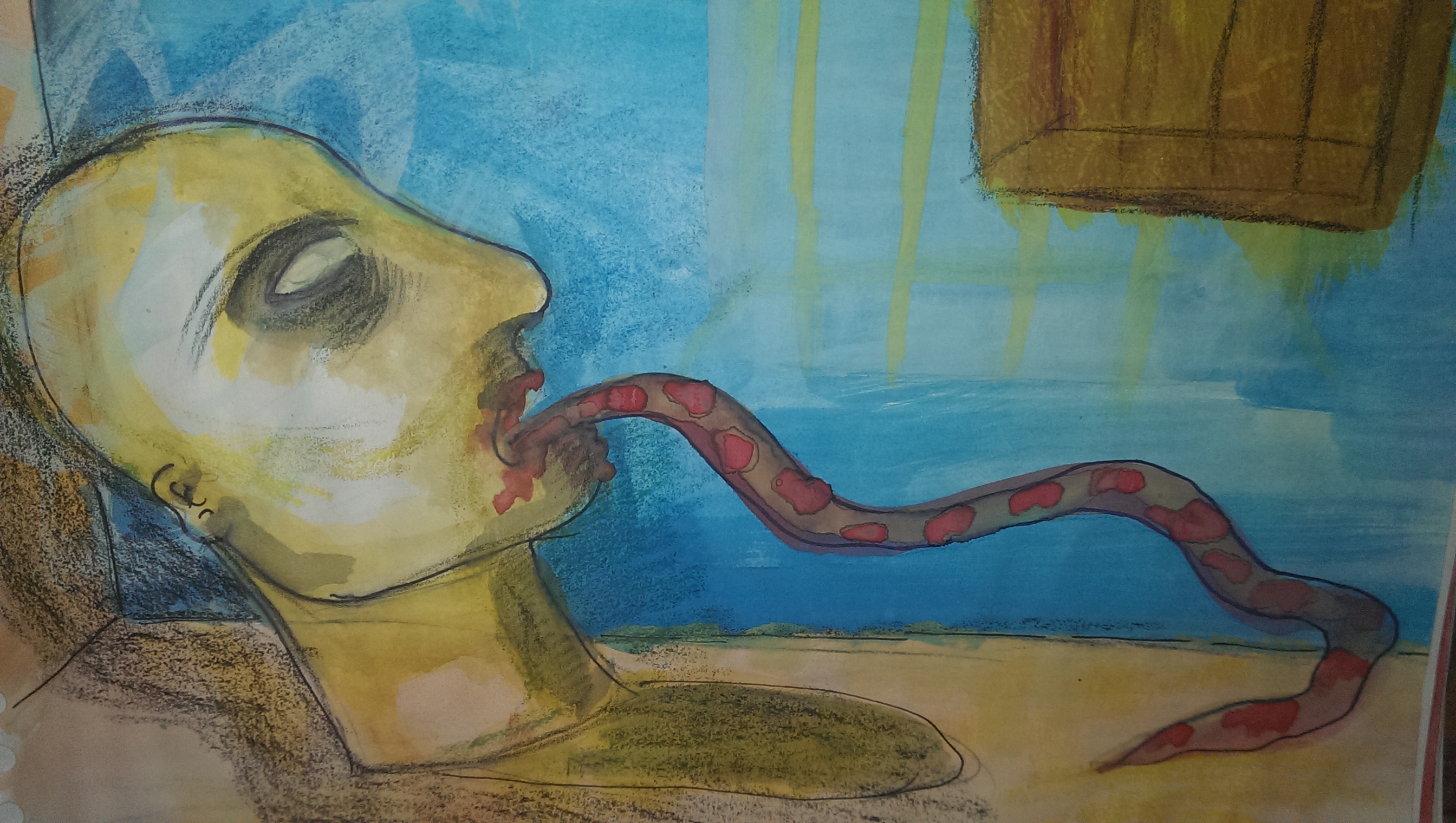
Buddhism reminds us that the ‘self’ is a construct by the ego, and that we should use the opportunity, when the ground is swept out from beneath us, to experience ourselves at an energetic level in terms of the vibrations we generate, and use the teachings of the Buddha to change our energy; to send out more positive vibes, to be of help to others when we can. In the immediate aftermath of the brain injury (6-12 months) I went ‘made of steel’ in an attempt to navigate a world which had bitten me on the arse and could, therefore, no longer be trusted. It took a lot of meditation to begin to dissolve those walls built out of fear and, along the way, I learned about a man called Avalokiteshvara who, so moved by the suffering that he saw in the world, segmented his head into several pieces, like a satsuma, so that he could ‘look with compassion’ on every person, in every direction, who was suffering. Nothing else of what I read stuck in my mind 3-6 months after the brain injury, except that, and I can still remember where I was sitting, outside Sainsbury’s on Garratt Lane, Earlsfield, resting during a bike ride, when I read it.
I don’t remember what I ate or drank, and I don’t remember anything else about the bike ride but, years later, when Daniel was about three months old and we were living with my mum and my stepdad, meditating and remembering this Bodhisattva made it easier for me to acknowledge the difficulties in which I felt consumed, and enabled me to check my desire for suicide. I couldn’t write or make art at the time and, indeed, I felt shrivelled and diminished and with nothing worthwhile to say, but this memory stayed my hand when I would have sought to take my life.
After the brain injury, odd things floated up out of the darkness and touched me for reasons I couldn’t specify at the time. I realised, a few months after the injury and when I was out of the hospital and spending a couple of days at a time at home, that I had achieved a place in one of my favourite poet’s works – Toads Revisited by Philip Larkin describes “Waxed-fleshed out-patients/ Still vague from accidents” and I felt a peculiar thrill when I remembered this, and cycled home to riffle through my Collected Poems until I found it. It took ages, but it was a fragment of a ‘me’ who somehow still tried to burn along those damaged neural pathways, and I felt reassured.
Apropos of which, when Roger McGough mentioned that Philip Larkin was the librarian at his alma mater university, ten days or so ago, I felt a thrill of energy; a puzzle piece in me resounded somehow. And so, despite my neurotic pursuit of 10,000 footsteps a day and a need to exercise in order to be able to eat and function well, I know I must make time for these words, which will come out. They must. Or I am worthless.
I have grown unused to sitting still, as I had used to do, with books; I have an impatient brain, eager to contribute something rather than to sit still, like the autodidact in Camus’ La Peste, learning; but this is what I know I need to do, and to try to remain undaunted by the task ahead: to read and to remember, to give my brain the information that it needs and craves because, in spite of everything, it is a clever brain. Slower, sure; but intelligent, and there I must give credit where it is perhaps overdue.


