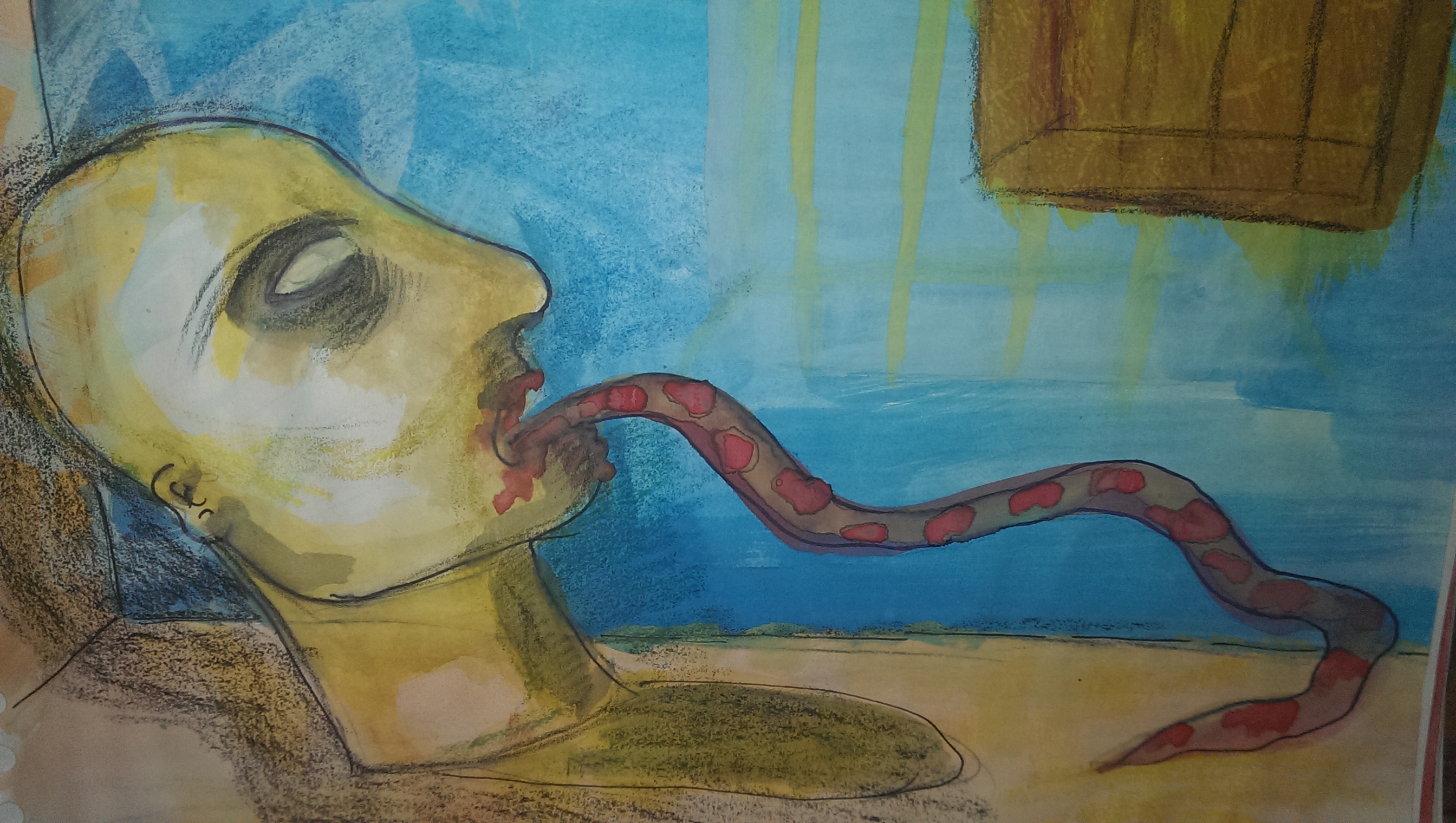
To end the silence takes courage; to say the things that go against the ‘norm’; to challenge the way things have become; to step out of the shadows of one’s own insecurities and say THIS IS WHO I AM.
Sixteen years ago the universe saw that I was on the backfoot from a series of self-sabotaging misadventures, and it cleared the slate.
Months later, with post-concussive vision, the world seemed gauzy, dreamlike and, above all, hostile.
People judged and gossiped; i felt half rubbed -out and insubstantial; my coping mechanisms had gone and my nociception was altered. This made self-harm more difficult; but this came out in other ways. Food limitation and a lot of cycling; then, later, the binge-purge cycles of bulimia pushed me into an adrenaline buzz and gave me bruised and puffy eyelids.
At that time I had a supportive doctor, who increased my SSRI dosage and referred me for outpatient help. As my son was still a baby I was eager to deal with this before he might notice and, possibly, inherit an unhealthy relationship with food. Over time, and with the help of 12-Step meetings, I was able to interrupt the cycle and begin to step towards freedom.
My son was diagnosed with Autism Spectrum Disorder when he was five years old. Suddenly, it seemed as though I was being told that I couldn’t understand my own child, that I would need support to raise him. The statement of Special Educational Needs only seemed to cause more difficulties: the mainstream school unofficially excluded him with the help of the local authority case worker; the case worker seemed earnest but stupid. It later turned out that he was dragging his heels as well, and the sense of impending doom was enormous, especially now that my hormones and I were not friends. I had always had PMT but, in the wake of the brain injury, this was magnified, along with previously manageable depressive symptoms.
Following a breakdown I was thankfully on appropriate medication but, when my son was out of school and out of the education system, and nobody in the neighbourhood whose children were still at the school checked in on us, I began to feel that we were being outcast, and I did the best I could to cope — physical exercise had always been important but now, more than ever, it proved to be my salvation.
I had been to a conference about sensory issues in children with autism, and proprioceptive activity had been shown to have a calming effect for some children. My son wasn’t keen on sports at all (neither was I when I was a child), but I tried weight training and Thai boxing, and these had a tremendously positive effect. I became slightly better coordinated, slightly more confident in my own capabilities, and able to eat with impunity on more occasions than I had been able to do beforehand.
I felt more calm and capable than I had done in a long time; it had a similar effect to cycling for extended periods for me, which was not so easy to do now that I was the single parent of a small child. The gym became my Happy Place and, some evenings? I spent happy times on the treadmills and the weights machines. Swinging kettlebells became instantly appealing and accessible, since these could be bought in the large supermarket, and stored with ease at home. Simply having an eight kilo kettlebell with me was enough, at times, to alleviate some of the suicidal thoughts and tendencies that I found I was now plagued by, especially at times like Christmas.
My son got into a school which was perfect for him, and this was something which, from 2019, gave me some freedom to go to the gym, see my psychiatrist, and try to assess what my life had now become. I still wasn’t quite sure who I was, and this new ’breakability’ evaporated my self-confidence. Only when I worked out did I find I made the energy that I needed to get through the days and weeks and challenging situations: my stepfather’s long illness and death; difficulties my son had with other kids at school; this weird unfathomable fatigue that I wasn’t sure had anything to to do with brain injury but was convinced that it might.
Exercise enabled me to challenge this, and to make more energy. As long as I took my meds and got enough rest, I could keep from sinking into a suicidal morass which now occasionally tried to eat me alive.
I cannot emphasise enough how extremely unsettling and frightening it is to sustain an injury that makes you lose your sense of self; takes away your coping mechanisms and leaves you plagued by self-doubt and exhaustion. On top of this, having to fight for every little thing for your child because they have special educational needs and dealing with the sense of isolation from the other ‘neurotypical’ families with their play dates and social lives takes energy you never knew you might need. Working out came in again, to enable me to feel a little less alone and a little more like life could change for the better somehow, someday, if I just put one foot behind the other one day at a time.
This, and AA, sustained me by helping me to develop coping mechanisms and giving me the illusion of a social life; although, over time, the differences grew when other people’s children went to school, or played out with friends, and mine did not because there remains the overhang from those days when no-one made an effort to check in on us.
My life has shrunk, in a way, since brain injury because of the periods of depression and the greater exhaustion that I experienced until about a year ago. The challenges became enormous when the school my son was attending was bought by another organisation, whose chaotic transition of management style, database and methodology caused alarm for many families. My son was more frequently unhappy and dysregulated; the staff did not appear to listen or to understand, and the sense of anxiety about my son’s safety at school was magnified when a failure to communicate between two staff members meant that a dangerous situation was not averted in which, thankfully, my son was not injured.
It became increasingly apparent over time that the school’s new owners were not placing the welfare of the pupils first, and parents of over half of the pupils at the school complained collectively and individually. I was one of those. After complaining and things seeming to get worse, I kept my son at home for the sake of his safety, and emailed the school, the local authority and Ofsted to alert them to my reasons for this. These were ignored, and the school called an Interim Review, in which they offered rolled my son, in my view, unlawfully, having failed to meet his needs for a year. The local authority, whose job it is supposed to be to ensure that children with an EHCP receive the appropriate education and support as set out in this document, had failed to keep an eye on developments and changes, and it seemed that there was nowhere to go for redress.
Having had to fight for years to get my son’s legal rights met has an effect; the news broadcasts about children killed by their parents when the Social Care departments have failed to intervene has an effect. The GP surgery having ignored letters from consultants about my depression and need for supervision over a three year period has an effect. The scream in my head like a carapace tightening around my skull for sixteen years has an effect.
The sense that, when it comes to brain injury, no-one understands or cares, has an effect. I have lost friends because they didn’t understand; because they talked about their lives and the things they were able to do, but the scream in my head kept on and on, and they didn’t seem to care. I know now that it was because they couldn’t hear it and I couldn’t talk about it that those people are not in my life anymore. I miss one person in particular, because we had used to go out together but remained friends through my drug addiction, his marriage and all sorts of things after we had left our teenage years behind. I don’t even know whether I said anything to him or not; but he hasn’t tried to contact me, and this, with my wiring the way it is now, feels like abandonment.
I was glad to leave London when people in AA proved to be unsupportive, gossiped or had seen me in the hospital after the accident. It became like a guilty secret that I wanted to erase, to escape; and when my son’s father said something about “all the people who said you were nasty” it cut me to the core. My behaviour immediately after the injury had changed, it was true; but I could only see little bits and only when I looked back, and my embarrassment battled with the sense that I had not been fairly treated by people for a long time.
It was someone in particular who helped me to step outside my limitations. Feeling that no-one understood, I got in touch with someone from my old brain injury support group, whom I had had a crush on. He had felt the same way, and we made plans to be together. He moved in so many clothes and possessions to my house, and we embarked on a journey to be a family. However, it went too fast for my son and it also became apparent that this man and I were at different stages of the healing process, and that he and I were, ultimately, very different people with different priorities in life. He left in something of a flounce, but something had begun to happen for me; I had begun to have therapy to try to address my newfound neurodivergent profile; and the difficulties that I couldn’t seem to dislodge from my psyche.
Six years of working out and two years of therapy have enabled me to reach this point, at which I can see that the silence that my depression has made me keep needs to be challenged, or else.
The title of this is an homage to somebody who, without knowing it, has walked beside me for most of my life and who has helped to pull me back from the abyss on many occasions. Whether it really is them on the end of the emails is immaterial; they have been my Muse forever, and I am learning to walk tall in my own skin through an affinity that I have always had with them.

 Fascinating Purgatory - A Guided Tour