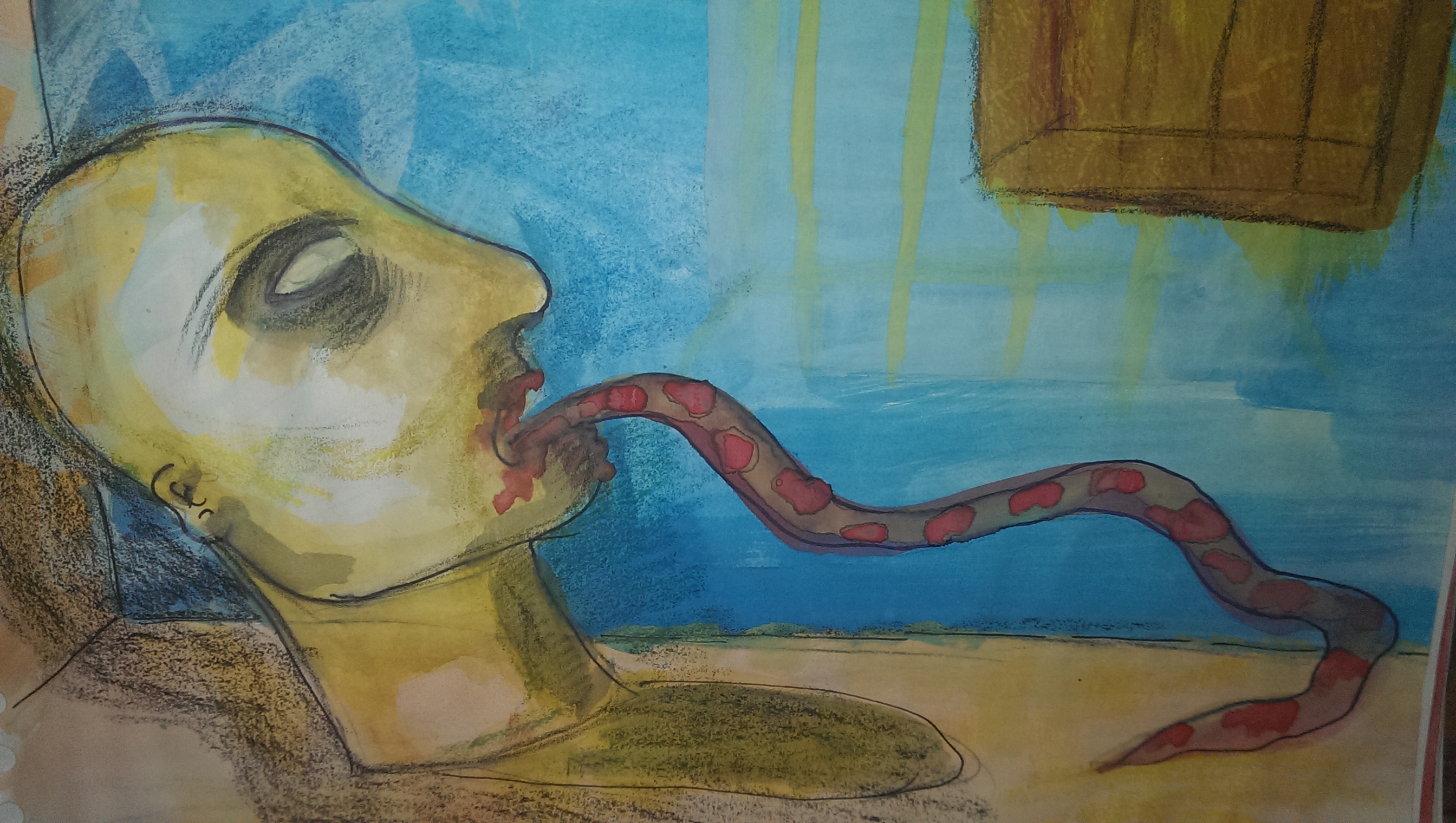
Let’s talk about the Blind Side and the Invisible Children; about another way in which regimes slide into place out of seemingly good intentions.
Imagine that there was a school for children with special educational needs, which you can be assured will teach your children. There are so many of these schools across the country that you don’t stop to ponder what they teach your children. Nor do you pause to reflect on the nature of a franchise and its impact on the quality of what is being sold; the fact that what is offered here is purely semiotic: a sense of something that the reality never quite achieves. The reality may indeed be farther from the halcyon vision than you would imagine. This is because times have changed a great deal since you or I were at school.
These people are highly trained according to a quality standard which no longer exists. They have done courses in awareness or diplomas in, say, Autism. I have done a Diploma and a Master’s Degree in fine art, but you wouldn’t want to let me loose on the Sistine Chapel ceiling.
The school is owned by an organisation that practises a one size fits all code of practice: the children behave as one would expect them to in an ideal world and are punished when they don’t. Never mind that the organisation has behaved so badly for a year that when, in 2023, your child returns to school you expect that, in return for their harsh, punitive introduction, they will offer them the Taj Mahal of school buildings after a couple of vaguely excited updates during the summer holidays tease you with what strikes you as a very incomplete project. There will be ‘libraries’ in each classroom, something called a ‘break-out area’ and long, posh corridors which, frankly, make your child shudder because very few children with special educational needs have a fond recollection of mainstream school.
What they don’t tell you – and this is the substance of the difficulties you have been experiencing for a year – is that your expectations and the reality are very different; you wonder if you are going to be wowed by what’s been done during the holidays; the children are allowed in, but none of the parents are allowed to enter. You see an incomplete – looking structure through the railings which, as an ex-decorator, tells you that something isn’t right. There are blocks of wood beneath the threshold of the doors to classrooms from outside and, through another window, you catch sight of something looking like an oven or a refrigerator wrapped in cellophane.
Everywhere you look, there is disorder; new staff you haven’t been told about are looking over-jolly and ushering uncertain children into the new building; your son panics and becomes fractious and you look around for someone familiar, finding instead a portly rubber-faced woman with copper-dyed white hair whom you recognise from the Newsletter you received only days ago, about ‘exciting’ new developments. You shake her hand, “I presume you are <insert name>; pleased to meet you.” She smiles, which makes her face seem even wider, “Yes, that’s right” and offers no further information. You now project on to her as much goodwill as you can, telling her that your son is nervous and that the unannounced new staff are bound to cause unease, it being a school for children on the Autism Spectrum. She says, “We’re very excited about the building and the new era for the school, with much better resources” and you wonder if a key turns in the back of her neck to make her utter stock phrases.
When you are allowed to look inside the new structure, its incompleteness screams loudly. Your son has already been locked in one of the lavatories, which the staff member who looked for the screwdriver told you he couldn’t have entered, as it was a child’s toilet. Luckily, your son found that the lock, and the handle of the door fell off after some moments of struggling to escape. The ‘libraries’ are, in fact, half-built flat-packed bookcases – one per classroom; and the lack of topcoats on all of the walls is evident, even if the screens had been connected to the wires which are hanging out, capped off with carrier bags. Outside, in the corridor, a couple of coats of paint – perhaps primer – barely suffice to cushion the acoustic echoes afforded by the plasterboard dividing walls. You recall something about sensory issues in special educational settings in the Buildings Regulations Act 2013, stating that the acoustics must be carefully managed to avoid raised voices and reverberation, which can be distressing to children with autism in particular.
The portly, rubber-faced headmistress beams vacantly as you knock on hollow walls and peer into classrooms, tutting at the unpainted joinery. “We’re planning a sensory room,” she says, “It will be painted to look like a woodland and have soft furnishings everywhere. The children can go in there to feel calm.”
Her colleague, a lisping bearded man with a visible bald patch and receding hairline, enthuses about the “book vending machine” that they’ve got in one of the stairwells, as yet unwrapped.
“Book vending machine?” you are incredulous. Books aren’t things you can buy with coins or tokens, they are pathways to other worlds, to history, to philosophy and everything else, they are portals.
You know that this is an unfinished site; you’ve worked in such places before. You wonder how the school got clearance to admit pupils and staff at this premature stage, but you remember something about deadlines for funding; there is something about educational and remand settings which imposes an opening deadline if funding is to be granted.
Thankfully, you see a member of staff you already know, and gravitate towards them with your son.
For someone so inarticulate, she enthuses convincingly enough about the new building and the classrooms, saying, “They’re gorgeous” and inviting your son to come and claim a desk in the room his class has been assigned. “You’ve got five drawers,” she says, “The bottom three are yours, to put in what you want and the top ones are for work and learning materials belonging to the school.”
“Where are the things I left here last term?” he asks.
“Oh,” she gushes, “They’re in the hall,”
“The sports hall or the dining hall?” you interject.
“Well, it’s all one room at the moment,” she beams, “And all the boxes with all your things in them are in there and it’s a bit chaotic,”
“Chaotic?” you ask.
“All of the things and furniture from the old classrooms has been put in there while the building work was being done. The children have to be accompanied by members of staff, though, because it might be a bit dangerous if they go climbing on anything,” she says.
You suspect that the building work is as unfinished as the pictures, and now the reality, seem to suggest, and your hackles rise slightly.
“You’re gonna love your new classroom!” she enthuses, beaming from ear to ear beneath a hooked nose which, you can’t help but imagine, is because one or both of her parents are pirates.
You are now embedded in an odd dynamic: you don’t believe a word that these adults are saying, but you don’t want to judge too harshly in case the space inside the shoddy-looking building is gleaming and resplendent, which the tone of emails you have received from members of the Senior Leadership Team has led you to believe. Such grandiose tones must surely have a backdrop; this interior must surely match that. You ask to see the new classroom.
“We can’t let you see it as all of the parents would want to see, and we’ve got to get on with the classes and organising things” she says. “Why don’t you ask at the office? They’ll organise a proper look for you.” It sounds legitimate enough; you give your son a squeezy hug and tell him that today is a good day to go in as, if it’s awful, you’re only there for four hours, with a lunch break, so to take advantage of the shorter day. He acquiesces, and you come away with trepidation and misgivings as he is led into the site by the inarticulate but enthusiastic young woman with the hooked nose.
The previous term – in fact, during the year leading up to this moment – has given you ample cause for concern. The sudden introduction of rules by new staff members no-one told you about have caused alarm. The tone of the emails has changed from supportive and understanding to scolding and shrewish. Instead of responsibility on their side of Duty of Care to all children, and to manage the class members and dynamics, you find yourself receiving emails about your child “frightening” others by engaging in projects he has long been encouraged to pursue; you receive telephone calls from staff, saying that they have had to confiscate items which your son had previously been able to bring to school with impunity, saying that “bless him, he did the right thing” in handing the items over to staff. The tone of emails, however, increasingly makes you suspicious about the tactics used by the staff to convince the child to surrender whatever object or preconception they might have been led to believe were acceptable by the school’s previous owners.
This is about:
Worthy narratives on investment companies’ websites and on those of Special Educational Needs Schools in particular, versus the experience of families of being gaslighted and of fighting, but failing, to get their child’s needs met.
Children with more complex ASD profiles being off rolled in a bid to fill classrooms with more compliant kids, who can be manipulated as a funding source. Some of these more complex cases remain on-roll despite their inability to attend, thus skewing the statistics for the volume of Emotionally Based School Avoidance in reality in this country.
This is also about Shifting Goalposts:
Senior Leadership Team and regional and chief executive directors, issuing narratives about complaints procedure, penalties and sanctions, but only after the fact of something happening – for example, a child receiving an electric shock in a classroom with three staff members present. After the event, a narrative about health and safety training standards, to which all staff are required to adhere, but to which no staff member has adhered, are sent to the mother of the child in question who, furthermore, has had to fight for her child not to be off-rolled because there are so few educational places and support for children with SEND in the UK.
The face-to-face meeting, the transcript and the telephone call, and the email: all of these modes of communication allow for further confusion and abdications of responsibility. The person who telephones you was never the person at the ‘incident’; the person who saw the ‘incident’ referred to in the email can never be found or contacted directly; the executive or substantive headteacher in the face-to-face meeting relays aspersions apparently cast by other parents, and the staff member who introduced themselves in one capacity say they are now present at the meeting in another capacity. You wonder how the two are related and, in the course of your enquiries, find that the assumptions you had made are in fact incorrect, thanks to semantics.
The web site tells you that safeguarding is at the heart of school practice, as part of the Duty of Care by the school and its staff towards all of the pupils. However, on the ground, there is a different story which unfolds: an incident occurs in which a child receives a mains electric shock. There are three staff members in the room but none of them are attending to the child on a one-to-one basis; CCTV footage confirms the shock and the complaint response says that the lesson taking place was suitable for the pupils. However, your son, who was there, knows that no lesson was taking place and that the doorbell module had been provided by a staff member previously. Although the school says that no mains electricity is permitted to be used and that all staff have received full health and safety training, you know that the maintenance manager’s electrical work leaves much to be desired, and your son has witnessed this. In addition, although the school says , in its Behaviour Protocol, that “we work hard to ensure that expectations and standards are clear and consistent across the school” (page 3).
However, your son was frequently distressed to find that the standards and restrictions had not been made clear at all; he found that items were confiscated which he had typically brought in to school before its change of ownership, and that no changes were communicated in advance. Rules and restrictions were applied reactively and seemed therefore to be punishment, with the syntax in emails from the headteacher taking an admonitory and judgemental tone as opposed to supportive and aware of the school’s duty of care for each child, to be delivered through adequate health and safety practice and standards. A fidget board consisting of electrical switches is confiscated without prior notice of standards and safety and is featured in one of the school’s newsletters as “a circuit board that one of our pupils has made” as though it is the great achievement that it is. This piece of equipment has since been thrown away, by staff who contended that it was dangerous.
The sudden implementation of rules and restrictions is one of the reasons why you complained about a situation which could have resulted in your son being seriously injured in Spring-Easter 2023. Safeguarding is not, as far as you have investigated, being extended to some of the children, and your son is one of these unfortunates.
By far the worst piece of gaslighting has to do with your child having been off rolled. Forget, for a moment, that the school web site still contains images of a child that you know to have been off rolled in a similar, although quicker manner, to your son; there is a great deal of worthy syntax about safeguarding and so forth; but you know the story on the ground. It poses a farcical juxtaposition to the ‘top line’ or whatever these things are known as. You have occupied the sub-narrative; the parallel reality, the counterpoint to the surface spiel.
The portly rubber-faced headmistress has ordered you off-stage through a trap door called moral high ground. You were less than impressed with the way in which the school disposed of your child at the Interim Review last October, and you let the inarticulate hook-nosed girl know this in a telephone conversation shortly afterwards. You receive an email, however, from the Headmistress banning you from school property because, “The comments made during the telephone call are considered both abusive and offensive” but are not specified, “I do not feel it is appropriate to repeat the comments due to the offensive nature of them”. You wonder a) how the inarticulate young lady managed to convey such drama, and b) whether she was able to repeat the conversation verbatim because, well, she can hardly string a sentence together in any case.
You reply, expressing your surprise and dismay, and ask the questions that you had posed during the course of the telephone call. You receive no reply and, furthermore, the Headmistress behaves obstructively: instead of collecting your son’s belongings from the desk that he had occupied, she stipulates that you and he must make a list of items that he left, and that she will endeavour to collect these and to give them to “a named person” because you are not allowed on school grounds.
You want to write back: Dear <rubber-face>, How dare you attempt to occupy the moral high ground and restrict my actions; let me re-cap for you the reason why I refused to bring my son into your toxic septic tank of a school in the first place. Let’s go back to September 2022, no – Easter 2023; that is when the difficulties became apparent, because I spoke repeatedly to <specky balding beardy> in particular and to <villanelle> about them, and queried the sudden and unannounced implementation of rules by sudden and unannounced new staff members, who suddenly and without prior warning, it turns out, were keen to grab children like excited crabs and remove them from the classroom for the slightest imposition, which was invariably made up and could have been avoided if appropriate speech and perhaps de-escalation strategies had been used in the first place.

 Fascinating Purgatory - A Guided Tour