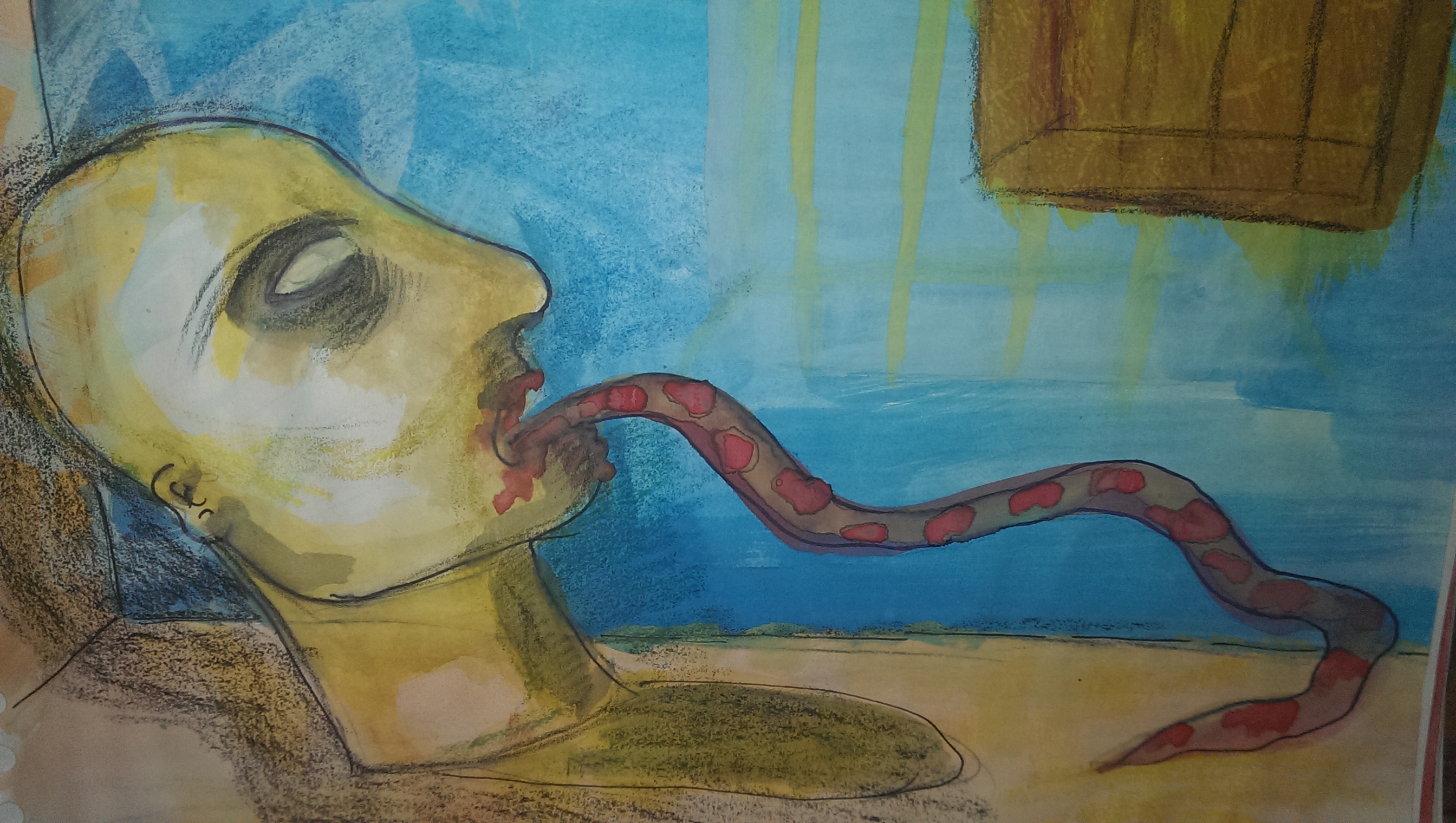
Ever since my brain injury at the end of 2007, I haven’t known where hormones end and depression begins and, to be honest, when I look back, I realise that I have never known: puberty, when I was 13, kicked off a great deal of difficulties for me about living in my own skin – a place where, thanks to my neurological wiring, I had never felt comfortable.
Now that the UK is on Lockdown in a bid to arrest the spread of Covid-19, despite the loveliness of there being fewer cars and more cyclists on the roads; the quiet privacy of walking when everyone maintains a two-metre distance; and the extraordinary capabilities of technology to keep us somehow connected, or at least to give us access to ideas from all over the world about how to do everything and anything, something in me senses keenly the general fear and uncertainty.
It feels something like ‘the calm before the storm’, but this is different: we don’t know what the storm will actually look like; we don’t know if this is the storm; we don’t know how safe any of us is from the virus that is claiming so many lives and, while I try to keep out of hysteria and remain rational, I feel afraid. I suppose that, in this sense, I am no different from any other mother. I thought about saying ‘parent’ but, since my son was born and his father and I split up, fatherhood seems to be something that Daniel’s dad occasionally tries; but has consisted more of excuses than of effort over the years.
My son’s dad’s clan are closed, tight-lipped, insular folk; unforgiving in the most bizarre way: my son’s dad lost his own father before he was born, to Leukaemia, and was brought up and adopted by the man his mother subsequently married, an alcoholic burned-out Belfast Policeman. This man and my son’s dad’s mother had a daughter, on whom, it seems, a hand was never laid. However, the upbringing administered to the boy was different; brutal. After my son’s dad told me about the abuse that he had sustained at this man’s hands, I didn’t want to meet his mother. Even before I became a mother, I would not tolerate any mistreatment of my child and yet, it seems, she forgave that man time and again.
My son has never been to stay with his paternal grandmother; she sends cards to his dad’s address now but, at one time, cards had used to appear addressed to my son, with the surname altered to exclude my own. After we had split up, I told his dad that I would not consent to him taking Daniel to ‘Angryland’ (Northern Ireland) and, at one point, I debated with my mother whether to go along and stay in a nearby hotel lest this woman allow my son to be treated like she had let her own for years. The old man having died long ago, my son’s dad’s mother and sister remain over there, but contact has been minimal and I can’t say that this is not, to me, some relief.
There is much to be said in favour of the present situation in terms of simplicity and of clarification between wants and needs. According to Buddhism, when familiar ground is swept away (routines, et cetera) we meet ourselves more authentically: who we really are under the layers of consumption and distraction – Dukkha (craving and the attempted satisfaction thereof). Our striving becomes based on what we truly need. Thanks to my neurological wiring, my thinking mind (how we experience the brain we have) likes to tell me that I’m lonely, inadequate and incomplete.
A few years ago, in a meditation session at the Croydon Buddhist Centre – now Triratna Buddhist Centre – the monk who was leading the exercise read an excerpt from Cold Mountain, a collection of songs translated by Red Pine. It was during the first year after the brain injury, and what resonated for me at that point was the line, “Form says to shadow: where to?”
Over 12 years later, as I was meditating, this fragment floated up. It surprised me. I realized that its erstwhile resonance was because I dwelt in the shadows, looking to them for direction, as though traversing a Hall of Mirrors in which each reflection is distorted, and believing them to be real.
However, it is the Light to which I now turn to seek direction. The light illuminates the shadows, shows me where and what I need to heal; but I had used to get attached to the shadows and look to them to guide me, instead of the light that showed them up. I feel now that I had stepped into a Labyrinth and panicked in the darkness.
Once I sat still and calmed my mind, I understood that the shadows on the path were part of the path and, if I kept going, I would come into the light. Suffering is impermanent; yet I had tried to clothe myself in its weeds for years. Now, as a result of how I live and manage my wiring, I know that I am strong enough not to let the shadows overwhelm me. I have heard it said that the hardest lessons are the best teachers, and I can attest to the truth of that statement. I think of it in terms of ‘Baptism of Fire’ or ‘rude awakening’. Rude can mean both unpleasant and robust, as in ‘rude health’, which is a positive statement.
I was surprised yesterday when my Family Support Worker suggested that my son’s father might be asked to have him for an extra night over the Easter weekend (this weekend). I was surprised because, during Lockdown, I have learned that we can get on with things at a relaxed pace; that it is okay to get bored sometimes, and that people are more than happy to go to the supermarket for odd items that I might need.
That position of dependency and vulnerability in which I had imagined myself is illusory. I am enjoying the Lockdown as it’s a time to reset expectations, engage in practical tasks, and be the role model that I want to be for my child. It is really quite a revelation, and I find that the need for respite diminishes as I place myself under less pressure to keep my son entertained, and relax into engaging in various tasks and activities to which I invite him, without pressure, to participate. I cannot pour from an empty cup, so it is important for me to attend to my needs (exercise, art, writing, reading etc.), the better to be able to be emotionally, physically, and mentally, available for my son.
Lockdown simplifies life; it shows what is important. Without the frippery and distraction of going out to get things done (the gym, the supermarket and so on), one is brought face-to-face with oneself ‘warts and all’ and finds, if not sufficiency, then the need to heal the demons that remain, or will always try to crowd in, thanks to my neurological architecture. It nicely separates the wants from the needs, and shows that life isn’t about chasing the next ‘vital thing’ but about seeing what we have in a new light, realizing how to make better use of the resources that we have. It imbues everything with new potential, previously unrealized. For example, whilst exercising in the garage this afternoon, I realized that the runners for the garage door, with the addition of my son’s discarded ‘selfie stick’ for a more comfortable grip, are perfect for practicing pull-ups.
This isn’t confinement; it’s containment, and an opportunity to see more fully both the capabilities and the potential which surround us. The Lockdown invites me to see more keenly, and to appreciate anew, the home we live in and the things we have.
As for my son’s father, I can really see his insufficiency; I am not the person that I was as little as one year ago, and feel that I have indeed benefited from several instances of ‘Baptism of Fire’ over the years. A couple of weeks ago, with the Easter Holiday approaching, I sent a text message to him asking about his availability to share time with our son in order to give the boy more variety and me more opportunity to get out of the house. The reply that I received astonished me: “We’re still working full-time, albeit from home so weekends are okay but we’re not by any means ‘off’. M is also classed as extremely vulnerable so on a 3-month home stay and can’t go out. With that when D comes you’ll have to just drop him at the door and I’ll bring him in. We’re not having anyone else in the house to keep everyone as safe as can be.”
I sent my mother a copy of this, and wrote that, in my opinion, they are a little hysterical and seem determined, or delighted, to make as hard work of anything as they can. In all the years of excuses over effort, this highlighted an insularity that excludes even one’s own child. It was the case, about a year and a half ago, that stress took its toll on me when the Local Authority failed in its duty to grant my son his legal right to an education. He had been unofficially excluded from the mainstream school that he was attending, by the suggestion that a more suitable place of education be found for him for year 3. Unfortunately, that didn’t happen, and there was a year of strife, which I will not go into here except to say that Thai Boxing is a wonderful outlet for a recovering alcoholic who can’t afford resentment. Stress isn’t something that I can accommodate in my mind and body without needing relief – which, due to the anxiety that my mind places on me anyway, is liable to be in the form of overeating, self-harm and, in the final analysis, once all other forms of relief have been tried, and have failed, to take a drink and use drugs.
I found, in that year in which the Local Authority failed my child and thousands of others, that stress was having a more detrimental effect on me than it has ever had before. Since the brain injury, my sensitivity (to put it lightly) to hormonal fluctuations has been magnified and, during that year, the effects of cortisol in addition to the usual hormones put me through hell. There were many times when I wanted to drink and, Christmas not being an easy time for me since Jules died in 1998, Christmas 2018 represented a catalogue of pain, and every strand of tinsel looked to me like a noose which, without my son, would have helped me to carry out the frequent ideations, about which, after a while, I became almost sanguine.
My son’s 8th birthday party was a rapidly-cobbled-together affair, to which I invited the children of the parents whose contact details I still had, thanks to the school’s inefficiency in removing our details from its roll. A selection of little snots that we were never likely to see again were dropped off, or accompanied by parents with whom the common ground had disappeared, and the house became noisy space filled with rampaging children, high on cakes and other sweet treats which, frankly, over-stimulated and exhausted me. My son’s father, enquiring about the state of play with the Local Authority, asked what more needed to be done and I told him flatly: “You need to step up; you do the bare minimum as it is.” I did not go into the holidays that he and his wife have had while my own family ‘holidays’ have merely meant tranferring chaos to a new location; I didn’t go into my frequent suicidal and self-harm ideations and my leaning on my mother because I found it hard to cope. I simply stated the truth.
I received a telling-off from his wife, who towered over me and said, “What?” I began a sentence with, “I’m on medication as it is -” and was cut short immediately. “You’re not the only one with a chronic condition, sweetheart,” she said, glaring at me in such a way that, when the words ‘slimming world’ appeared in my brain, they died in my throat. Not to lose face, I said, “Which is?” to which she replied, “None of your business.”
“Well,” I managed to say, “That helps” and grimaced at her. At this point, my father interjected with the words, “This is not the time or the place for a discussion of this sort” and brought the exchange, thankfully, to a close. Biting back tears, I turned away and swept crumbs from the kitchen worktops and refilled the kettle, bitterly aware of the eagerness, on the part of the Irish (my son’s dad and his wife), to win a sainthood or trophy for Most Hard-Done By.
An email from my son’s father followed, two days later, admonishing me and I saw starkly the reality of things: he is not going to do any more than the one night per fortnight stay for my son, and wasn’t going to volunteer a penny more to cover the growing costs of a child at home who should be at school – legal or otherwise. I also began to see that this lack of effort was indeed the next best thing to the man going under a train, for which I had prayed many times before and after we had split up.
I began, though unable to see this at the time, to cast aside the victim’s weeds in which I had, by default, clothed myself. Now, almost two years later, I see that he is, to a larger extent, irrelevant, and this gives me some sense of relief as my son grows bigger and I grow more capable of a good many things. During Lockdown, I redecorated my son’s bedroom, which included stripping wallpaper and filling large cracks and holes with Interior Ready-Mixed Smoother; basic skimming; priming and painting. I then built my son’s bed, cleared the waste traps under the kitchen taps and moved furniture around to make better use of the space in our house downstairs.
Feeling more capable and confident in myself, I began to imagine myself a little like a ‘Rambo’ figure – tough and burly, adept at survival and – perhaps unlike Rambo – not bad at baking biscuits.
However, something remained in me and this was the sense that fatigue was my lot as the survivor of a severe traumatic brain injury, and my support worker mentioned this not infrequently. Indeed, a neuropsychiatrist with whom I finally had a telephone consultation after years of being largely ignored by my GP practice, seemed to back up the validity of this, and his recommendations on ‘sleep hygiene’ have not gone unappreciated. Curiously enough, though, in a conversation with my father in which I said that I had looked on the Headway web site and found that “it’s real” – people who have had a brain injury not uncommonly suffer with fatigue, he said, “Don’t underestimate the ageing process in making one feel more tired. You are, axiomatically, twelve and a half years older than you were at the time of the accident.”
I felt furious at having my imagined heroics debased by something as mundane as middle-age. How very dare he, I expostulated to my sponsor, and how very silly I felt, too. I felt like the little girl at the end of the party who hadn’t been given a goody-bag; thirty chronological years dropped away as I imagined covering his toilet seat with toothpaste in revenge; at my age, and – I saw that he had a point. “You’re not Rambo” said my sponsor.
Harrumph. I had to concede the point. And then something wonderful happened. One Monday, a couple of weeks ago, I did my weight-training workout in my garage, as usual, and went to the Post Office to post a letter. On my return, I ate some lunch and became aware that I wanted to have a nap. It was with tremendous delight that I kicked off my socks and pulled the duvet over myself: I wasn’t having a nap because I’m damaged, fragile and a bit broken; I was having a nap because I’m a single mum, I’m middle-aged and, by God, I deserve a rest.
I work out three to four days a week and I am allowed to rest because I’m not just a weightlifter, or a boxer; I’m a mum, an artist seeking to rekindle my productivity after years of falling into different patterns of behaviour after brain injury, childbirth, and all sorts of things. Houses don’t clean themselves and, when I do the housework, my gratitude for such a lovely home for my son and myself is reawakened.
I am grateful for the period of Lockdown this year: my AA meetings are all by Zoom, which requires me to dial in over the internet using my ‘phone; I don’t have to spend money on petrol or time driving to or from meeting venues; I can put my son to bed, log on to the meetings, and go straight to bed at the end. I have no problem refraining from entering my son’s father’s home when I drop him or collect him at the garden gate; if they want to preserve a citadel of long-suffering for themselves, then far be it from me to pop the bubble of their martyrdom. My son seems to have a nice, if slightly boring, time, and if he doesn’t want to go, then I won’t make him. We’re too busy having a blessed life to care anyway.

 Fascinating Purgatory - A Guided Tour